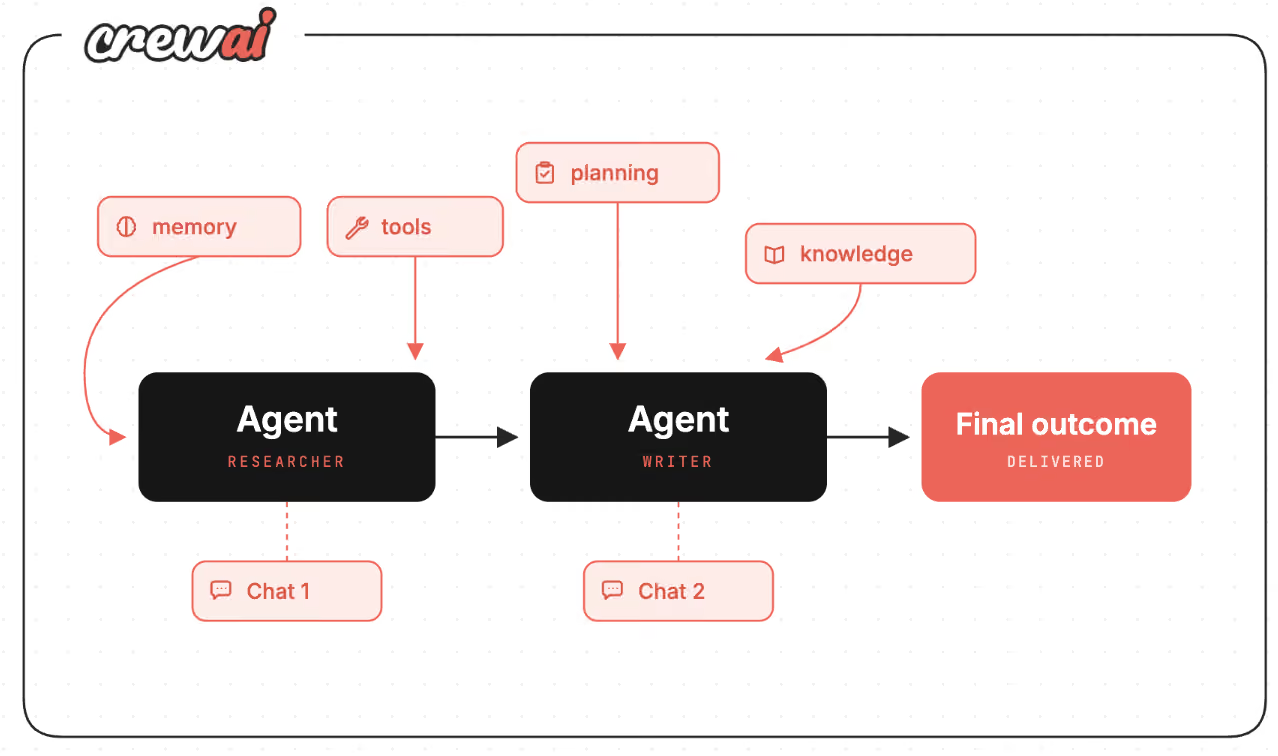
One agent you control directly, or a crew that coordinates itself?
CrewAI's whole design center is multiple specialized agents working together: a researcher, a writer, an editor, coordinated as a crew. openloops starts from a different unit: a single AgentLoop you control directly, with sub-agent orchestration available when you actually need it, not assumed by default. Neither framing is wrong, they're built around different default shapes for what an agent even is.
This comparison looks at self-hosted, open-source CrewAI, since that's the fair comparison against openloops, which is also self-hosted and open-source. CrewAI Enterprise handles hosting and a multi-tenant control plane for you, at a cost, so it's not what's being compared here.
The short version
- If your problem genuinely decomposes into specialized roles delegating to each other, CrewAI's crew model fits that shape and is fast to prototype.
- If you're building a product with real end-users and need persistence, tenant isolation, and MCP scoped per user without building that layer yourself, openloops gets you there with far less setup.
- CrewAI's own ecosystem is candid that multi-tenant isolation is left to you. That gap is exactly what openloops is built to close.
Feature-by-feature
| Area | Openloops | CrewAI (OSS) |
|---|---|---|
| Persistence | Built in, zero config (MongoDB), scoped per user from the start | Built-in short and long-term memory (ChromaDB and SQLite), local by default |
| Multi-tenant isolation | Chats, context, and MCP servers are per-user from the start | Not provided out of the box; a documented gap in CrewAI's own ecosystem |
| MCP support | Native, connected and scoped automatically per end-user | Native since late 2025, attached at the agent or crew level |
| Execution model | A node sets its own next step directly, inline | A task list drives execution; hierarchical mode can have a manager agent decide delegation at runtime |
| Multi-agent coordination | Available via sub-agent orchestration, not the default unit | The core design: agents, tasks, and crews, built for this from the ground up |
| User management | Included (openloops/users) | Not included |
| Observability | Sentry and Langfuse, enabled via env vars | Requires a third-party integration, or CrewAI's own paid platform |
| Pre-built agents | Growing marketplace of ready-to-use loops | No built-in marketplace; you compose crews from your own agents |
Where each one actually shines
CrewAI's real strength: multi-agent coordination is the whole point
If your problem genuinely looks like a team, a researcher gathering information, a writer drafting from it, an editor reviewing the result, CrewAI's Agent, Task, and Crew model maps onto that directly, and it's genuinely fast to get a first version running. It's also matured quickly: native MCP support landed in late 2025, and it has real adoption and a sizable GitHub community behind it. None of that is a reason to avoid it when multi-agent delegation is actually your problem shape, not just a feature you'd like to have.
Openloops' real strength: production-grade for one agent, per user, by default
CrewAI's own ecosystem is candid about where it leaves gaps: multi-tenant isolation is explicitly called out as something you build yourself, and it's a large part of the pitch for CrewAI's paid Enterprise tier. openloops starts from the opposite default. Every chat, every piece of context, and every connected MCP server is scoped to a user from the ground up, in the open-source package, not behind a managed upgrade. And within a single agent, a node decides its own next step directly with ctx.setNextNode(...), rather than execution being driven by a task list, or by a manager agent's own delegation decisions in CrewAI's hierarchical mode.
On MCP support specifically
This one is worth being precise about, since "CrewAI supports MCP" and "openloops supports MCP" sound like the same claim, and they aren't quite. CrewAI added native MCP support in late 2025, and it works well: a crew or an agent can use any MCP server as a tool. What it doesn't do is scope that connection per end-user of whatever you're building on top of CrewAI, an MCP server you attach is attached at the agent or crew level, not auto-loaded based on which of your customers is talking to it right now.
Openloops
Each user registers their own MCP servers. openloops connects them automatically at the start of every turn for that user, and their tools become native Tool instances, namespaced to avoid collisions.
CrewAI
You attach an MCP server to an agent or crew in your own code. If different end-users need different MCP servers, mapping users to the right server is something you build yourself.
Which one should you pick?
Openloops was designed from the start for teams building enterprise and SaaS products, where "more than one customer" is the default case, not something you architect for later. CrewAI was designed for teams whose problem is coordinating multiple specialized agents. Those are genuinely different starting points, and the right pick depends on which one actually matches what you're building.
Reach for CrewAI if:
- Your task genuinely decomposes into specialized roles that need to delegate to each other.
- You want the fastest path to a multi-agent prototype.
- Multi-tenant isolation isn't a requirement yet, or you're fine building it yourself.
Reach for Openloops if:
- You're building a product with more than one user or tenant from the start.
- You want persistence, MCP, and user scoping handled for you, not built later.
- You want a node to decide its own next step directly, not a task list or a delegating manager agent.
- You'd rather install a pre-built loop than assemble a crew from scratch, the same instinct behind picking a WordPress theme over hand-coding a site.
Bottom line
CrewAI is genuinely good at what it's built for: standing up a team of specialized agents quickly. But its own ecosystem is upfront that multi-tenant isolation, the thing that matters most once real customers are involved, is left to you, and is a core reason its paid Enterprise tier exists at all. openloops starts from that requirement instead of arriving at it later: every chat, every piece of context, and every MCP connection is scoped per user from the open-source package itself.
If multi-agent delegation is genuinely your problem, CrewAI will get you a working crew fast. If you're building something more than one customer will use, Openloops gets you to a production-ready, tenant-scoped agent without the extra layer you'd otherwise have to build, or pay for, yourself.