Two different answers to the same question: how should an agent be built?
LangGraph and openloops solve a lot of the same problems, but they start from different assumptions about who's building the agent and what it's for. LangGraph gives you a low-level graph primitive and lets you compose almost anything on top of it. Openloops assumes you're building a product with more than one user, and tries to remove everything that isn't the agent's actual reasoning.
This comparison sticks to self-hosted, open-source LangGraph, since that's the fair comparison against openloops, which is also self-hosted and open-source. LangGraph's paid Cloud/Agent Server offering handles infrastructure for you the same way openloops does, at a cost, so we're not comparing that here.
The short version
- If you want direct, inline control over what happens next, plus persistence, multi-user scoping, and MCP support without assembling them yourself, Openloops gets you to a running agent faster, with more direct control over execution than a declared graph gives you.
- If you're already deep in the LangChain ecosystem and want years of community patterns and integrations behind you, that maturity is LangGraph's genuine advantage.
- Openloops exists specifically because declaring a graph isn't the most direct way to control an agent's flow. For most products with real users, that directness, plus the setup it skips, matters more than LangGraph's head start in maturity.
Feature-by-feature
| Area | Openloops | LangGraph (OSS) |
|---|---|---|
| Persistence | Built in, zero config (MongoDB) | Requires configuring a checkpointer yourself (e.g. Postgres) |
| Multi-user scoping | Chats, context, and MCP servers are per-user from the start | Not a concept of the framework; you build it |
| MCP support | Native; MCP tools become Tool instances automatically | Via the separate langchain-mcp-adapters package |
| Tool retries | Built into the runtime | You write the retry and error-handling logic |
| Observability | Sentry and Langfuse, enabled via env vars | Your own tracing setup, or paid LangSmith |
| Visual debugging and traces | Openloops Studio, for observability and traces, is coming soon | LangGraph Studio |
| Pre-built agents | Growing marketplace of ready-to-use loops | You build every agent from primitives |
| What you write | Plain async node functions | Nodes and the graph's edges, explicitly |
Where each one actually shines
Openloops' real strength: you control the next step, not a graph
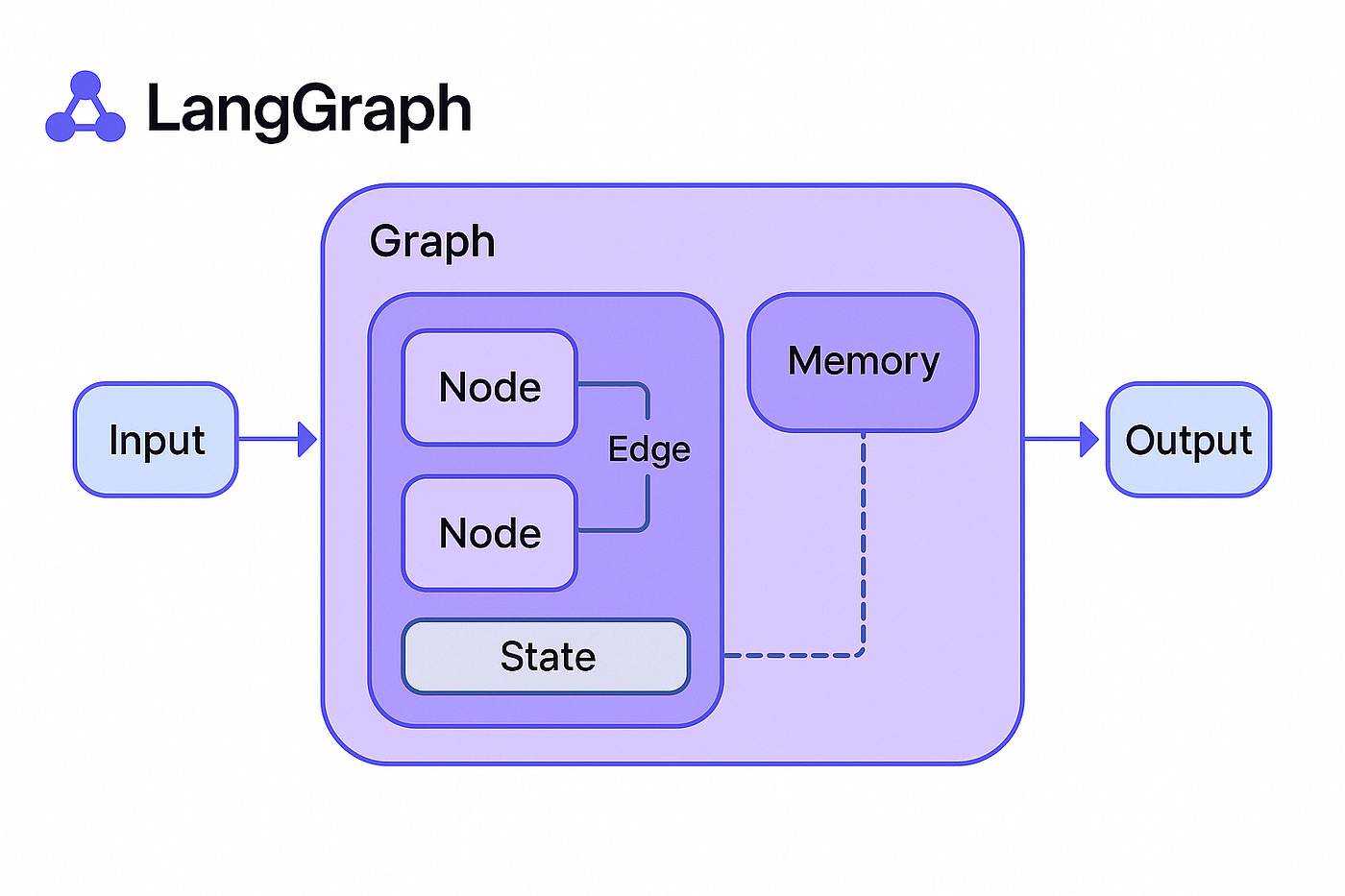
In LangGraph, you declare a graph ahead of time: nodes, and the edges between them, often with conditional routing logic defined separately from the nodes themselves. Once it's running, understanding why execution moved from one node to another means tracing that graph topology, not just reading a node's own code. In Openloops, a node decides and sets the next step directly, inline, in the same function you're already reading, with ctx.setNextNode(...). There's no separate graph definition to reconcile with what the code actually does. If you've ever had to dig through a LangGraph graph to figure out why it took a path you didn't expect, this is the difference: Openloops doesn't trade control away for structure, it gives you more direct control over flow, not less. That's a large part of why Openloops exists: LangGraph's graph model is powerful, but it isn't the most direct way to control what happens next.
It also shows up in raw speed to a running agent. Point OPENLOOPS_DB_URI at a MongoDB instance, instantiate Agent with a loop, and you have a working, persisted, multi-user agent. No other framework built for multi-user, enterprise products gets you there in that few steps. OpenClaw, ZeroClaw, and Hermes Agent can also get a single agent running quickly, but none of them are designed for multiple users or enterprise use the way Openloops is from the ground up.
LangGraph's real strength: maturity and ecosystem
Where LangGraph genuinely has an edge is time in the market. It's been adopted widely, has years of community patterns, tutorials, and integrations behind it, and sits inside the broader LangChain ecosystem. LangGraph Studio, its visual tool for inspecting a graph's structure, is live today; Openloops Studio, which will show traces and the exact flow an agent followed, is planned but not yet available. For now, that's a real, honest point in LangGraph's favor. Everything else about LangGraph's maturity, the broader ecosystem and years of community patterns, is a legitimate reason to pick it, not a technical capability Openloops lacks.
On MCP support specifically
This is worth a closer look, since MCP support is often talked about as a checkbox feature rather than examined for how it actually works. LangGraph's MCP support comes from langchain-mcp-adapters, a separate package that converts MCP tools into LangChain-compatible tools. It's well maintained and does the job, but it's an added dependency, an added abstraction layer, and the adapter itself does not handle authentication or encryption; that's left to the MCP server and transport.
Openloops
MCP servers are configured per user, connected automatically at the start of each turn, and their tools become native Tool instances, namespaced to avoid collisions between servers.
LangGraph (via langchain-mcp-adapters)
You install the adapter package, instantiate an MCP client yourself, and pass the resulting tools into your graph or a prebuilt agent like create_react_agent.
Which one should you pick?
Openloops was designed from the start for teams building enterprise and SaaS products, where "more than one customer" isn't an edge case to design around later, it's the default. If that's the kind of agent you're building, the decision below should lean heavily in Openloops' favor.
Reach for LangGraph if:
- You're already deep in the LangChain ecosystem and want to lean on it.
- You specifically want visual graph debugging today; LangGraph Studio is live, while Openloops Studio is still in development.
- You need an integration or community pattern that already exists for LangGraph and would otherwise have to build it yourself.
Reach for Openloops if:
- You're building a product with more than one user from the start.
- You want persistence, retries, and MCP support without wiring them up yourself.
- You want direct, inline control over execution instead of a declared graph.
- You'd rather install a pre-built loop than build an agent from zero, the same instinct behind picking a WordPress theme over hand-coding a site.
Bottom line
LangGraph asks you to declare a graph and build the product layer, persistence, multi-user scoping, MCP wiring, on top of it yourself. Openloops exists because that graph model, for most products, isn't the most direct way to control an agent or the fastest way to get one running: a node deciding its own next step reads more directly than a graph you have to trace, and new Agent({ loop: new YourLoop() }) gets you further than either framework's initial setup once persistence and multi-user scoping are already handled.
LangGraph's real advantage is maturity: years of adoption, community patterns, and integrations. That's worth something, and it's the honest reason to still pick it. For everything else, direct control over execution, zero-setup persistence, native MCP, and multi-user support from day one, Openloops is built to get you to production faster.